
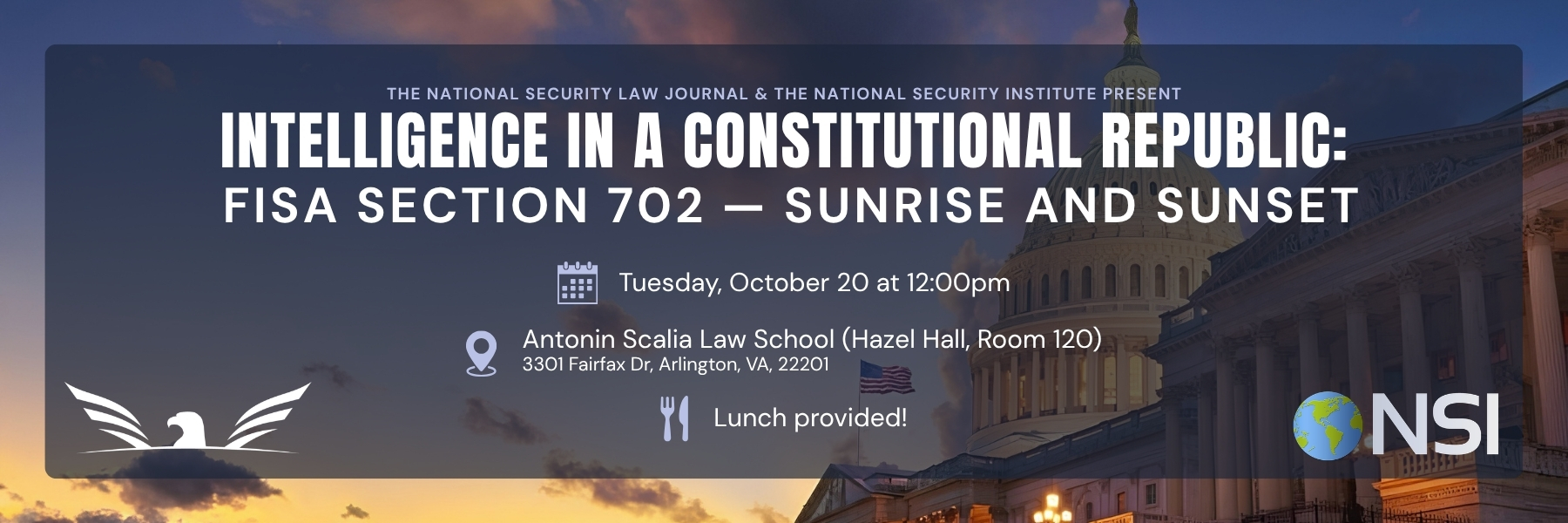
The National Security Institute and the National Security Law Journal is hosting the Spring Symposium panel “Intelligence in a Constitutional Republic: FISA Section 702—Sunrise and Sunset” as part of the 2026 – 2027 Series, Intelligence in a Constitutional Republic.
“Intelligence in a Constitutional Republic: FISA Section 702—Sunrise and Sunset” will explore the legal, constitutional, and national security issues surrounding Section 702 of the Foreign Intelligence Surveillance Act (FISA) as Congress approaches its scheduled expiration. Panelists will discuss Section 702’s role in U.S. foreign intelligence collection, the constitutional and civil liberties concerns raised by the program, and the legal safeguards governing the collection, querying, and use of Section 702 information.
The discussion will also examine the ongoing debate over reauthorization and reform, including the appropriate balance between protecting national security and safeguarding individual privacy and constitutional rights. Drawing on perspectives from government, academia, and national security practice, the panel will consider the future of Section 702 and the broader role of intelligence authorities in a constitutional republic.
Date: Tuesday, October 20
Time: 12:00 – 1:30 PM
Location: Hazel Hall, Room 120
3301 Fairfax Drive
Arlington, VA 22201
Food Provided
Speakers:
- Tara McFeely – Chief Operating Officer, National Security Institute (NSI)
- George Barnes – Former Deputy Director, National Security Agency
- Andrew Borene – Executive Director, Ocient National Security Solutions; Former Group Chief, National Counterterrorism Center
- Glenn Gerstell – Former General Counsel, National Security Agency
- Andy Keiser – Former Chief of Staff, House Permanent Select Committee on Intelligence
Tara C. McFeely

Tara Caroselli McFeely is a senior national security executive with expertise spanning defense, intelligence, and technology policy, political, and budgetary domains. She serves on the Strategic Council at Silverado Policy Accelerator, advising on innovative, data-driven national security policy initiatives, and is an Adjunct Professor in the Master of Science in Foreign Service program at Georgetown University’s Edmund A. Walsh School of Foreign Service.
In government, she most recently served as the Republican Deputy Staff Director on the U.S. Senate Select Committee on Intelligence (SSCI) driving the national security and intelligence policy and Executive Branch oversight strategic direction. She also co-led the professional staff oversight functions of the policies and programs of the U.S. intelligence enterprise spanning six Departments: Defense, Energy, Homeland Security, Justice, Treasury, State; and two independent agencies: the Central Intelligence Agency and the Office of the Director of National Intelligence. Prior to this role she served as the SSCI Budget Director, leading the staff oversight of the Intelligence Community (IC) and Defense Intelligence Enterprise annual $100.0+ billion budget and programs. Formerly, she was the SSCI Chairman’s Senior Advisor for Counterterrorism and the Federal Bureau of Investigation’s intelligence programs.
In the research domain, Ms. McFeely was the Deputy Director of the Intelligence Analyses Division at the Institute for Defense Analyses. In this role she led a large team of senior social sciences and STEM researchers on complex multidisciplinary research and analysis projects. At Booz Allen Hamilton, she was a senior advisor for multiple IC and Department of Defense clients. She also led numerous multifaceted contracts across the U.S. Government landscape globally, including multilateral counter-Biological Weapons (BW) program initiatives. Ms. McFeely began her career serving globally in the U.S. Navy, initially as a Surface Warfare Officer conducting U.S. 2nd Fleet and NATO operations across the Atlantic, and subsequently as a Naval Intelligence Officer supporting operations in the Balkans and the Global War on Terror.
Ms. McFeely has a Bachelor of Science in Political Science from the U.S. Naval Academy where she was a letterwoman on the Women’s Varsity Basketball Team. She also has a Master of Arts in Law and Diplomacy (MALD) from The Fletcher School of Law and Diplomacy, Tufts University.
George Barnes

George C. Barnes is the President of Red Cell Partners’ Cyber Practice and a Partner at the firm. Mr. Barnes applies his national security and cyber domain expertise to the pursuit of cyber start-up incubations spanning commercial and government sector applications. Complementing his Red Cell focus, Mr. Barnes engages in advisory activities supporting numerous public and private sector entities, including the U.S. Navy, the Institute for Defense Analyses, the Auburn University McCrary Institute for Cyber & Critical Infrastructure Security, the Virginia Tech National Security Institute, the CSIS Cyber Force Commission, and Billington Cybersecurity. He also chairs the National Cryptologic Foundation Board of Directors.
Prior to joining Red Cell, Mr. Barnes served as the Deputy Director and senior civilian leader of the U.S. National Security Agency (NSA) from April 2017 through September 2023, capping off a 36-year NSA career. In this role, Mr. Barnes served as NSA’s chief operating officer, overseeing strategy, policy, and operations. As an agency deputy in the U.S. national security system, Mr. Barnes supported the U.S. defense and intelligence enterprise in national security strategy execution and the formulation of supporting policies, positioning NSA as an integrated mission partner enabling U.S. decision advantage and security against foreign threats.
Mr. Barnes holds a Bachelor of Science in Electrical Engineering, and his government career impact recognition includes three Presidential Rank Awards and top-level civilian service awards from the Secretary of Defense, Chairman of the Joint Chiefs of Staff, and Director of National Intelligence.
Andrew Borene

Andrew “Swede” Borene is a licensed attorney and Vice President of National Security Solutions at Ocient, serving government and multinational enterprise AI missions. With a career bridging national security law, intelligence operations, and advanced technology, he is a Certified Information Systems Security Professional (CISSP), a Senior Fellow at George Mason University Law School’s National Security Institute and serves on the editorial board of the “Connections” journal on international security cooperation at the George C. Marshall Center for European Security Studies.
Previously, Andrew spent over two decades across the U.S. intelligence community. His public service included senior roles at the Office of the Director of National Intelligence (ODNI) and the National Counterterrorism Center (NCTC), where he served as Group Chief of an interagency team handling counterterrorism policy and planning across the Middle East, Asia, Europe, and Africa on behalf of the White House National Security Council. He also served as an Associate Deputy General Counsel at the Pentagon and held advisory roles at IARPA and CIA. He is a U.S. Marine Corps combat veteran.
In the private sector, Borene has served as CEO of a publicly traded cybersecurity company and held executive roles at IBM, Symantec, Booz Allen Hamilton, and LexisNexis. He holds a J.D. from the University of Minnesota Law School and a B.A. in Economics from Macalester College. He is a former U.S. State Department Fellow in Northern Ireland and past recipient of the FBI Director’s Award and the ODNI Exceptional Achievement Award.
Glenn S. Gerstell

Glenn S. Gerstell served as the general counsel of the National Security Agency (NSA) from 2015 to 2020. A frequent guest commentator on CNN, MSNBC, and NPR, he has written and spoken widely about the intersections of technology and national security, with articles appearing in the New York Times, Washington Post, New Yorker, The Hill, Barron’s, and POLITICO. Prior to joining the NSA, Mr. Gerstell practiced law for almost 40 years at the international law firm of Milbank, LLP, where he focused on the global telecommunications industry and was the managing partner of the firm’s Washington, D.C., Singapore, and Hong Kong offices. Mr. Gerstell served on the President’s National Infrastructure Advisory Council, the Future of Encryption Committee for the National Academies of Sciences, Engineering and Medicine, and the District of Columbia Homeland Security Commission. A graduate of New York University and the Columbia University School of Law, Mr. Gerstell is an elected member of the American Academy of Diplomacy and a member of the Council on Foreign Relations. Earlier in his career, he was an adjunct law professor at the Georgetown University Law Center and New York Law School. He is a recipient of the National Intelligence Distinguished Service Medal, the Secretary of Defense Medal for Exceptional Civilian Service, and the NSA Distinguished Civilian Service Medal.
Andy Keiser

Andrew “Andy” Keiser served for 14 years on Capitol Hill, notably as Senior Advisor to the House Intelligence Committee and Chief of Staff to its Chairman, Mike Rogers. He helped shepherd six Intelligence Authorization Acts into law, securing funding for all 17 U.S. intelligence agencies, and advanced landmark cyber threat-sharing legislation later signed by President Obama.
Dubbed a “national security expert” by The Washington Post, Mr. Keiser is a regular media commentator featured on Fox News, News Nation, The Wall Street Journal, and Politico. Previously, he was head writer for a nationally syndicated radio program and assisted in producing CNN’s Declassified.
Mr. Keiser is an active scholar, serving as a Senior Fellow and Guest Lecturer at George Mason University’s National Security Institute (NSI) and a Senior Fellow at the Center for the Study of the Presidency and Congress (CSPC). He also serves as an Adjunct Professor at Pepperdine University and is a member of the OSS Society. He holds a B.A. from Michigan State University and an M.A. from the U.S. Naval War College.
Mr. Keiser has written extensively on technology and national security and has testified before Congress on threats posed by Huawei and ZTE. His recent publications focus on U.S.-China technology competition, including papers on semiconductor export controls, restricting outbound investment to targeted Chinese sectors, the race for 5G, and countering state-backed semiconductor companies.